Curiosity
The car-sized rover that landed in Gale Crater in 2012, found that ancient Mars could have supported microbes, and has since climbed 1 km up Mount Sharp.
- Status
- Operating
- Launched
- 2011
- November 26
- Size
- 2.2 m
- 7 ft
- Built by
- NASA
- $2.5B
- life-cycle cost after a two-year launch delay; first estimate $1.6 billion
- 1 km
- elevation gained up Mount Sharp, August 26, 2026
- 5,000
- Martian days on the surface, reached August 30, 2026
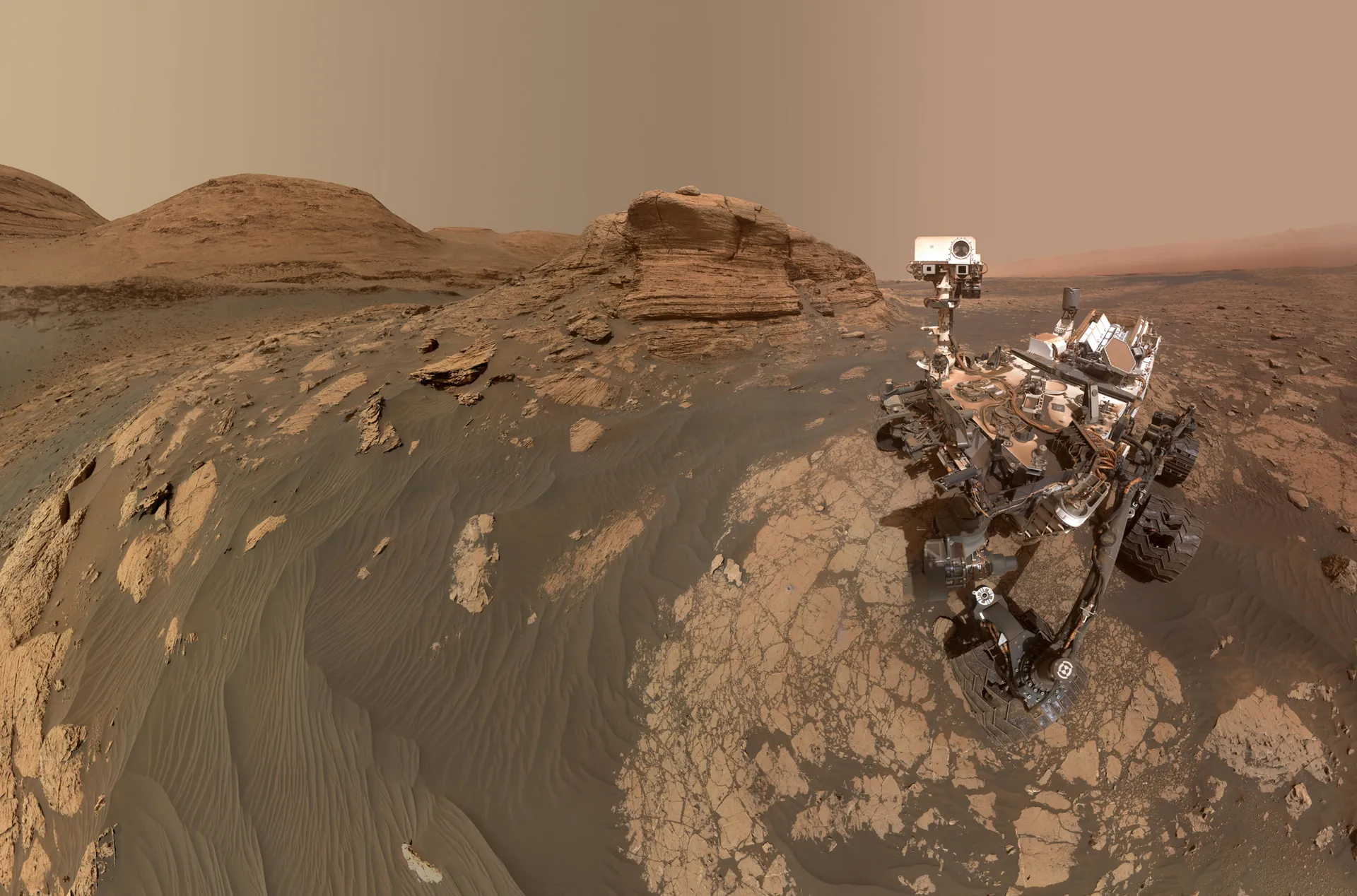
Curiosity, the rover of NASA’s Mars Science Laboratory mission, was the largest and most capable rover ever sent to Mars when it launched on November 26, 2011. It set out to answer whether Mars ever had environmental conditions that could support microbes. About the size of a small SUV and weighing 1,982 pounds (899 kilograms), it carries 10 science instruments, 17 cameras, a rock-vaporizing laser and a drill on a 7-foot arm; the drill powders rock for the laboratories inside the rover’s body.
The rover was meant to launch in 2009. Late components and instruments pushed it to the 2011 window, raising its development cost from $969 million to $1.8 billion and its life-cycle cost from $1.6 billion to $2.5 billion, according to NASA’s Inspector General.
Curiosity landed in Gale Crater on August 6, 2012, lowered to the ground on tethers by a rocket-powered “sky crane.” Seven months later it had an answer to its question: powder drilled from a mudstone called John Klein, at a spot named Yellowknife Bay, held clay minerals and sulfur, nitrogen, hydrogen, oxygen, phosphorus and carbon. The site had been the end of an ancient river system or an intermittently wet lakebed where microbes could have lived. Its Sample Analysis at Mars laboratory has since found organic molecules in Martian rock; in 2025 scientists reported the largest yet found on Mars, and in April 2026 seven carbon compounds never detected there before. Neither find settles whether life or geology made them.
Since 2014 Curiosity has been climbing Mount Sharp, a 3-mile-tall mountain of layered rock in which each layer records a different time in the planet’s history. It has drilled more than 40 rock samples. On August 26, 2026, it marked 1 kilometer of elevation gain, and on August 30 its 5,000th Martian day.
Where Curiosity appears in the atlas
Sources
- 1
- 2
- 3
- 4
- 5
- 6
- 7